
Guide · Comparison · Yu-Gi-Oh
NARUTO CARD GAME vs Yu-Gi-Oh: how the two games differ
Players who tried the demo keep calling Bandai's game Yu-Gi-Oh with a resource system. Here is where the comparison holds and where it breaks, rule by published rule.
Quick answer
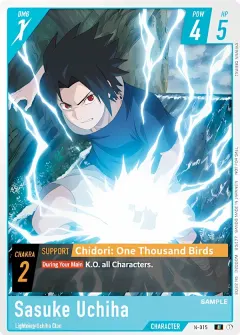
The two games share a shape, a monster board with attacks and effects and a face-down trap layer, but almost none of the mechanics. The NARUTO CARD GAME is built around a Leader with 15 Life who can either attack or refresh your Chakra each turn; Yu-Gi-Oh has no leader and no resource system, and you win by taking 8,000 Life Points off the opponent. Naruto deploys one Character per turn by resting a dedicated Summon card and has two attack stats, DMG against the Leader and POW against rested Characters; Yu-Gi-Oh has one Normal Summon per turn and a single ATK value against monsters or the player. Naruto decks are a fixed 1 Leader, 50 main deck, 5 Chakra and 1 Summon; Yu-Gi-Oh decks are 40 to 60 cards plus an Extra Deck. Yu-Gi-Oh has 25 years of cards and a comprehensive rulebook; Bandai's game has 29 revealed cards, a how-to-play guide and a June 2027 release.
The most-watched review of the Gen Con demo asked, in its title, whether the NARUTO CARD GAME is "just Yu-Gi-Oh but better". It is the comparison players reach for first, because the table looks familiar: characters in a row, attacks declared, face-down cards waiting behind them. This guide goes through the published rules of both games and marks where the likeness holds.
Everything on the Naruto side comes from Bandai's how-to-play guide and its October 2026 announcements, as transcribed on our rules page. The Yu-Gi-Oh side is Konami's official rulebook. Where Bandai has not published a rule, the row says so.
The side-by-side
| NARUTO CARD GAME (Bandai) | Yu-Gi-Oh! TCG (Konami) | |
|---|---|---|
| Status | Releases June 2027; 29 cards revealed; how-to-play guide only | On sale since 1999 (Japan) and 2002 (English); comprehensive rulebook |
| Deck | 1 Leader, 50 main deck cards, exactly 5 Chakra, exactly 1 Summon | 40 to 60 cards in the Main Deck, up to 15 in the Extra Deck, optional 15-card Side Deck |
| Life | The Leader's Life, 15 on both revealed Leaders | 8,000 Life Points, no leader card |
| Resource | Chakra: 5 cards face-up at the start, turned face-down as they are spent; refreshed only by resting the Leader | None. Monsters are summoned by level and tribute, spells and traps are free to activate |
| Deploying | Once per turn by resting the Summon card; EX Characters and card effects deploy in addition | One Normal Summon or Set per turn; Special Summons in addition |
| Attack stats | Two per card: DMG when attacking the Leader, POW when attacking a rested Character | One ATK value, used against monsters and against the player |
| Who you can attack | The Leader, or a rested Character | Any face-up or face-down monster, or the player directly when the field is empty |
| Turn | Draw Phase, Main Phase; no refresh phase | Draw, Standby, Main 1, Battle, Main 2, End |
| Face-down plays | Support Characters set face-down, activated on the opponent's turn for Chakra | Trap cards and Quick-Play spells set face-down, activated for free when their condition is met |
| Board | 5 Characters, 5 Supports, 1 EX Character, 5 Chakra | 5 Main Monster Zones, 5 Spell and Trap Zones, 2 Extra Monster Zones, Field Zone |
| Deck-out | Not published | Lose when you cannot draw |
| Copy limit per card | Not published | 3 copies, subject to the Forbidden and Limited List |
Where the comparison holds
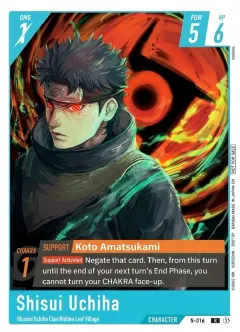
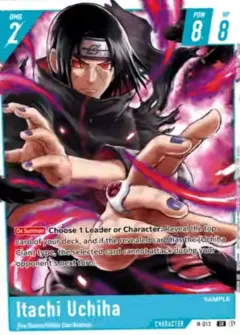
A row of attackers and a row of face-down answers. Both games put characters in front and reactive cards behind. Naruto's Support area does what Yu-Gi-Oh's Spell and Trap zone does from a player's point of view: it hides something that goes off on the opponent's turn. Gen Con demo players reported hand traps and at least one Support that negates another Support, which is Yu-Gi-Oh's negation layer in all but name.
Big characters with conditions. Naruto's EX Characters cannot be deployed normally; their printed Summon Requirements, which demo players said put your own Characters in the trash, read like tribute summons. The EX Character area holds one, much as the Extra Monster Zone constrains where Extra Deck monsters go.
Attacking into monsters or the player. Both games let you choose. Naruto narrows it: you may attack a Character only when it is rested.
Where it breaks
The Leader. Yu-Gi-Oh has no card that represents you. Naruto's Leader is on the table from the first turn with 15 Life, can attack, and is also the resource switch: "Resting your Leader turns all your Chakra face-up again", and a rested Leader cannot attack that turn. Every turn you choose between pressure and fuel. Nothing in Yu-Gi-Oh asks that question.
Chakra. Yu-Gi-Oh famously has no mana. Naruto has five Chakra cards that are spent face-down and never refresh on their own; Bandai's guide says explicitly that there is no refresh phase. That changes the texture of a turn: a Jutsu or a face-down Support costs something, and a turn spent refreshing is a turn not attacking.
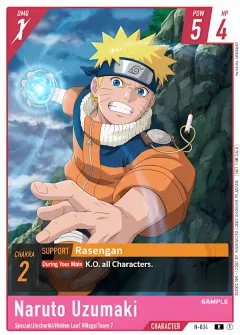
Two attack numbers. Yu-Gi-Oh's ATK serves for everything. Naruto's cards print DMG for hitting the Leader and POW for hitting a rested Character, so a card can be a fine Leader-attacker and a poor Character-killer. The revealed Leaders show the spread: Naruto Uzumaki N-001 has DMG 1 and POW 3.
The Summon card. Normal deployment in Naruto is gated by a single card you rest, and the rested Summon card is the hard once-per-turn limit. Yu-Gi-Oh's once-per-turn Normal Summon is a rule, not a card, and Special Summons have grown to dominate it.
Deck shape. Naruto fixes the count at 57 cards in four fixed pieces. Yu-Gi-Oh gives you a range and an Extra Deck.
What is still open on the Naruto side
Bandai has not published copy limits per card number, how the starting player is chosen, whether Character damage persists between turns, whether running out of cards loses, or a hand size limit. Any simulator or guide that answers those today is guessing; ours says so at each one. The comprehensive rules will almost certainly arrive between the Premier Demo Events in early 2027 and the June 2027 release of the three Starter Decks and Booster Pack 01.
If you come from Yu-Gi-Oh
You already understand the board, face-down interaction and conditional big summons. The things to relearn are the Leader's attack-or-refresh choice, the Chakra budget behind every Jutsu, and the two attack stats. The how to play walkthrough covers a full turn, and the glossary maps Bandai's terms (rest, Support, Jutsu, Summon Requirements) to what they do. For how the game compares with Bandai's own ONE PIECE CARD GAME, which is the closer cousin, see that guide.
Frequently asked questions
- Is the NARUTO CARD GAME just Yu-Gi-Oh?
- No. It looks like it from across the table, a row of characters attacking with face-down cards behind them, but the engine is different. Naruto has a Leader card with Life that doubles as your resource switch, a Chakra pool you spend face-down and refresh by resting that Leader, a Summon card that limits normal deployment to once a turn, and two attack values per card. Yu-Gi-Oh has none of those: no leader, no resource system, 8,000 Life Points, one Normal Summon per turn by rule, and a single ATK stat.
- Which is easier to learn?
- On the published rules, Naruto has fewer moving parts: two phases a turn, five card types, a fixed deck shape and a board capped at five Characters and five Supports. Yu-Gi-Oh's six phases, Extra Deck mechanics and quarter-century of card text make it the heavier game. Naruto's rules are also incomplete; Bandai has published a how-to-play guide, not a comprehensive rulebook, so the comparison is between a finished game and one still being revealed.
- Does the NARUTO CARD GAME have traps?
- Something like them. Support Characters can be set face-down in the Support area and activated on the opponent's turn, which Gen Con demo players described as hand traps and negates. Unlike Yu-Gi-Oh traps, every activation still costs Chakra, and the same card can instead be deployed as a Character or cast as a Jutsu straight from hand.
Sources
Every factual claim above traces to one of these. Where a detail is not in them, this page says so rather than filling the gap.
- Bandai, NARUTO CARD GAME official how-to-play guide (deck construction, turn structure, deployment, battle, Chakra, play areas), transcribed in docs/ncg-rules-spec.md and on the rules page
- Bandai, NARUTO CARD GAME Shows Its Hand press release, July 29, 2026 (card types, win condition)
- Bandai, NARUTO CARD GAME New Info Revealed! Oct. 2026 (June 2027 release, Starter Decks, Booster Pack 01)
- Konami, Yu-Gi-Oh! TRADING CARD GAME official rulebook (deck sizes, Life Points, phases, Normal Summon, Extra Deck)
More guides
- Most expensive Naruto Mythos cards: eBay asking prices, and what is really behind them
The top of our Naruto Mythos price index is a common Kurenai Yuhi at $61.46 and a run of Mission cards at $34.87. Open the listings and the reason is shipping, not scarcity. Here is the ranking as it stands, the Secret and Mythos rares whose listings really are the card, and why the gold cards have no price at all.
- Every Naruto CCG champion, and the GenCon tournament history that survives (2006 to 2013)
Five championships, four champions, five cards designed by the winners, thirteen events with a surviving result and four complete decklists. This is everything we could trace for Bandai's 2006 to 2013 Naruto CCG to a report written at the time, with the gaps left as gaps.
- The most expensive Kayou Naruto cards by asking price, October 2026
The 25 Kayou Naruto cards with the highest eBay asking prices as our index stood on October 27, 2026: the serial-numbered ASP and SE cards from the Tier 4 boxes, what each rarity code means, and the one headline figure we will not stand behind.